Salt air corrodes HVAC systems faster than almost any other factor. Here's what it does at the component level, and what coastal Sarasota homeowners should know before their next repair or replacement.

Sarasota's barrier islands, Longboat Key, Siesta Key, Anna Maria Island, Lido Key, are among the most desirable residential addresses on Florida's Gulf Coast. They are also among the most demanding environments for HVAC equipment in the entire country. The combination of salt air exposure, high humidity, and near-constant system runtime creates a degradation pattern that most homeowners, and most general HVAC content, never addresses in concrete terms.
In this article, Rob Brooks, owner and veteran technician at Gary Air, explains what salt air actually does to HVAC systems at the component level, how that corrosion progresses differently depending on distance from the water, what realistic lifespan expectations look like across Sarasota's coastal and inland communities, and what equipment choices and maintenance decisions make a meaningful difference for homes close to the Gulf.
Let's break down the key points you should consider.
Keep reading to understand the specific risks coastal exposure creates, and why the standard HVAC guidance you find online was not written for a home on Longboat Key.
What salt air actually does to metal components
Most homeowners understand, in a general way, that living near the water is harder on outdoor equipment. What is less understood is how that process works at the component level, which specific parts are most vulnerable, and how quickly the damage accumulates in the Sarasota coastal environment.
Understanding the mechanism is what allows a homeowner to make decisions about maintenance, equipment, and replacement timing that are actually calibrated to their situation.
Rob Brooks describes it plainly: "An HVAC system is mostly made out of metal components, whether they're copper, aluminum, or steel. And in many cases they're painted, like the outdoor cabinets and components. But inside, your wiring, your electrical connections, your coils, they corrode and they deteriorate as a result of being exposed to salt."
Salt air carries microscopic sodium chloride particles that deposit on every exposed metal surface. When those particles combine with moisture, which is abundant in Florida's climate, they initiate electrochemical corrosion.
The process is not dramatic or sudden. It is slow, continuous, and cumulative. Each day of exposure adds a layer of corrosion product to every unprotected metal surface inside and around the system.
The materials in an HVAC system are not equally vulnerable. Aluminum, used in evaporator and condenser coils, is particularly susceptible to the pitting corrosion that salt deposits initiate. Copper, used in refrigerant line sets and electrical connections, corrodes more slowly but is not immune, particularly in the presence of chloride ions from salt air combined with the sulfur compounds that industrial and marine environments can introduce. Steel cabinet components corrode at rates that depend on coating quality, which degrades with UV exposure over time.
According to the U.S. Federal Highway Administration, chloride-induced corrosion is one of the most aggressive forms of metal degradation in coastal environments, and the rate of corrosion increases significantly with proximity to saltwater exposure and relative humidity, both of which are consistently high in Sarasota's coastal communities.
The most consequential short-term effect of salt air corrosion in an HVAC system is refrigerant loss through pinhole leaks in the evaporator and condenser coils. Aluminum coils develop these leaks when salt deposits initiate pitting at points where the protective oxide layer on the aluminum surface has been disrupted, either by manufacturing imperfections, physical contact during installation, or the gradual thinning of the oxide layer through continuous salt exposure.
A pinhole leak does not cause a sudden system failure. Refrigerant escapes slowly, over weeks or months, until the system's charge has dropped enough to meaningfully affect cooling capacity.
The homeowner notices that the system is running longer than usual, that the house is not as cool as it should be, or that indoor humidity has increased even though the system appears to be running normally.
Rob describes seeing the most extreme version of this: a condenser coil on a unit that was only one year old, installed on the salt-water-facing side of a beachfront building, that had deteriorated to the point of requiring full replacement. "Their condensing unit coil, which is an aluminum coil, has deteriorated and it's only a year old and it needs to be replaced. It's literally on the saltwater side of the building." That case represents an extreme of proximity and exposure, but it illustrates what the same process produces at a slower rate in every coastal home.
The diagnostic implication is that refrigerant loss in a coastal home should never be treated as a maintenance item to be addressed by simply recharging the system. If the charge is low and no mechanical damage is evident, the source is a leak. In a coastal location, that leak is most likely corrosion-initiated, and recharging without locating and sealing the leak, or replacing the corroded component, produces a temporary fix that will need repeating.
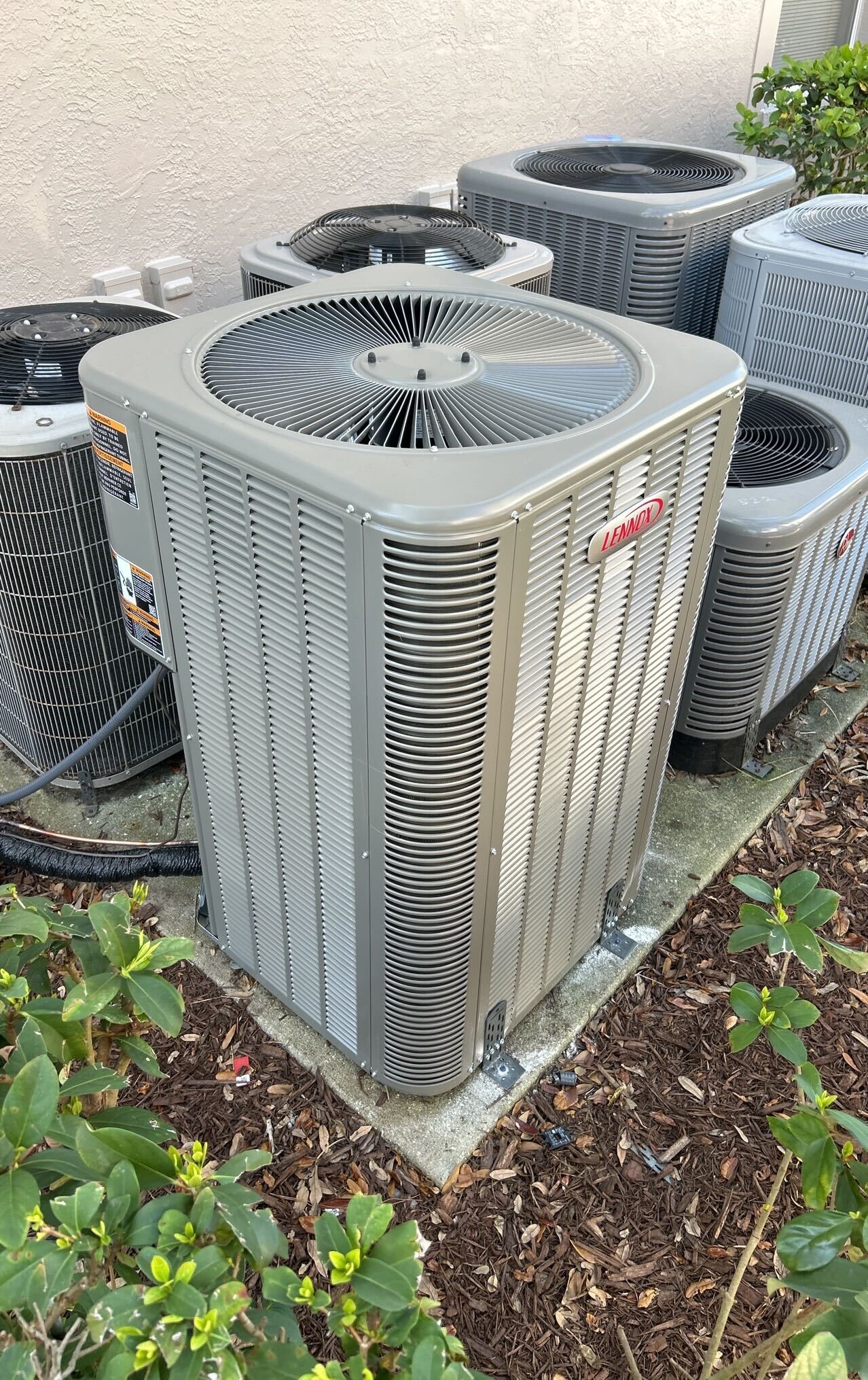
The condenser unit sits outside and faces whatever the prevailing air carries: Gulf breeze, humidity, rain, and salt. The orientation of the unit relative to the water and the prevailing wind direction affects how concentrated the salt deposition on the coil surfaces is. A condenser on the water-facing side of a building in a direct Gulf breeze accumulates salt exposure at a meaningfully higher rate than one on the sheltered side of the same building.
This is not something most homeowners think about at installation time, and it is not something most HVAC companies raise during a replacement proposal.
But for a homeowner on a barrier island spending $12,000 to $15,000 on a new system, asking where the condenser should be positioned to minimize salt exposure, and whether there is a practical alternative to the current location, is a question worth raising.
The electrical system: the most underestimated casualty
Coil corrosion and refrigerant leaks are the most visible consequences of salt air exposure because they produce a symptom the homeowner can feel: the house stops cooling. Electrical degradation from salt air is slower to produce a recognizable symptom, but it is often the more damaging process because it affects the control logic and starting behavior of the entire system.
Rob explains what distinguishes a coastal system's electrical condition from one inland: "We would see two homes of the same age in Lakewood Ranch versus Siesta Key. We would just see corrosion and deterioration of metal components, and definitely in the electrical system. Our systems are very, very sensitive to low voltage. And when you have electrical components that are starting to deteriorate, that low voltage doesn't flow through the electrical wiring correctly."
The low-voltage circuit in a residential HVAC system, typically 24 volts, controls the thermostat, the contactor, the reversing valve in a heat pump, and the sequence of operations that governs how the system starts, runs, and shuts down.
These circuits depend on clean electrical connections with low resistance. Corrosion increases resistance at every connection point it affects. As resistance increases, voltage available at the load drops below the threshold required for reliable operation.
The result is a system that seems to run intermittently, that starts with a delay, that trips safety switches without a clear mechanical cause, or that produces compressor hard-starts because the contactor is not closing cleanly. These symptoms are easy to misread as compressor problems or refrigerant issues.
A technician who is not specifically looking for corrosion-driven electrical resistance will often find the visible symptom, a failed contactor or a low-voltage fault, without identifying that corrosion is the underlying cause. The part gets replaced. The corrosion continues. The next failure arrives sooner than it should.
According to the National Association of Corrosion Engineers, corrosion is responsible for a significant portion of electrical equipment failures in coastal environments, and its progression accelerates when relative humidity consistently exceeds 60 percent, a condition that describes Sarasota's climate for most of the year.
Control boards in modern HVAC systems are printed circuit boards housed in the air handler and outdoor unit. They are not as directly exposed to outdoor air as the condenser coil, but they are not fully protected from the humidity and salt-laden air that circulates through the system during normal operation.
Over time, the combination of moisture and salt particles that enter the air handler through the return air stream can deposit on board surfaces and initiate corrosion at solder joints and component leads.
A control board that is beginning to fail from corrosion produces some of the most difficult-to-diagnose symptoms in HVAC service: error codes that appear intermittently, systems that reset themselves, behaviors that seem to resolve after a technician visit and then recur. The intermittent nature of early board failure makes it expensive to diagnose and easy to misattribute to other causes.
The HVAC common issues that present as random or intermittent failures in coastal homes are disproportionately likely to have a corrosion component that will not be resolved by replacing the presenting failure without also addressing the environmental conditions that drove it.
What realistic lifespan looks like across Sarasota
The lifespan of an HVAC system in Sarasota is not a single number. It is a range that varies significantly based on distance from the water, system runtime, maintenance history, and the equipment choices made at installation.
Understanding where a specific property falls on that range is the most useful piece of information a coastal homeowner can have when evaluating a repair quote or considering a replacement.
For homes on Longboat Key, Siesta Key, Anna Maria Island, and Lido Key, the realistic average lifespan of a properly maintained HVAC system is 8 to 10 years. Rob is specific about what drives this: "Anywhere that you are on Longboat Key, your systems are getting exposed to saltwater. You can expect for those systems to last between 8 to 10 years on average."
That figure reflects the combined effect of constant salt air exposure, high annual runtime, and the accelerated electrical and coil degradation that those conditions produce. It is not a reflection of poor equipment quality or inadequate maintenance. It is the expected outcome in that environment, regardless of brand or service history.
The implication for a homeowner who has recently purchased a coastal property is that the system's age matters differently than it would inland. A 6-year-old system on Longboat Key is in the final third of its expected useful life.
A 6-year-old system in Lakewood Ranch is likely in the middle of it. The repair-versus-replace conversation, and the AC lifespan extension strategies worth investing in, are materially different in each case.
Rob's advice for homeowners at that 6-to-8-year mark on a barrier island: "They can lean in early at that six-year range to see if there are any components worth changing out to provide some additional longevity. But working with a company that's honest with them about that is really important, because some people will take advantage of those types of customers."
Barrier island properties often change hands between full-time and part-time residents, and the runtime history of a system follows the occupancy pattern of the prior owner rather than the age of the equipment.
A system that was installed 8 years ago in a home occupied only 4 months per year has accumulated substantially fewer operating hours than a 4-year-old system in a full-time residence.
Rob notes that buyers of part-time residences can genuinely benefit from this: "There is a possibility that that system wasn't run as much as a normal system would be because it's vacant for many months out of the year. Customers can really benefit from that because their air conditioner will last longer as a result."
The caveat is that reduced runtime does not protect against salt air corrosion. A system that sits idle in a salt air environment is still accumulating corrosion on coil surfaces, electrical connections, and cabinet components. Low runtime extends the useful life of mechanical components.
It does not extend the useful life of metal components exposed to salt air. A corrosion inspection by a qualified technician is worth scheduling early when purchasing a coastal property, regardless of how many hours the prior owner ran the system.
Properties in Lakewood Ranch, North Port, Venice, and other inland Sarasota communities face the same humidity and runtime pressures as barrier island homes, but without the direct salt air load. The corrosion mechanisms described above are present at lower intensity, and the coil and electrical degradation they drive happens more slowly.
For inland properties, national lifespan averages of 12 to 15 years are more applicable, though Florida's runtime still compresses that range compared to northern markets. The emergency HVAC repair in Sarasota situations that drive replacement conversations inland are more often pure wear and runtime failures than the corrosion-driven failures that dominate barrier island service calls.
Equipment choices that matter most in coastal environments
When a coastal system reaches replacement, the equipment decision is more consequential than in almost any other residential HVAC context. The same equipment that performs well inland for 15 years may reach end of life on a barrier island in 8, not because of product defects but because the standard materials were not designed for that level of environmental exposure.
The standard aluminum coil used in most residential condensers and evaporators provides adequate performance in moderate environments. In high-salt-air environments, standard aluminum coils develop the pitting corrosion described earlier at a rate that drives premature refrigerant leaks and early replacement.
Rob describes the options available for coastal installations: "The closer you are to the water, we really recommend either our Lennox quantum coil technology, which is built to withstand specifically corrosive environments, or working with other brands and manufacturers. We have partners that can coat the materials with a permanent protective coating to help keep the systems lasting longer. We would really focus on doing that when we're within a few miles of the water itself."
The Lennox quantum coil was tested for 12 years in the salt flats of Puerto Rico, specifically to develop a coil material and construction method that maintains integrity in salt-saturated environments. Other manufacturers offer coated coils, where the aluminum coil surface receives a polymer coating after manufacturing that slows the initiation of pitting corrosion.
The coatings vary in effectiveness and durability. Asking an HVAC company specifically which coating is applied, by which manufacturer, and what independent testing supports the durability claims is a reasonable question before a coastal installation.
According to ENERGY STAR, selecting properly specified equipment for a home's specific climate and environmental conditions is one of the most significant factors in achieving the rated system efficiency and lifespan. In a coastal Florida environment, that specification includes corrosion resistance, not just SEER rating.
Rob is direct about the single most useful question a homeowner can ask before committing to a $15,000 system on a waterfront property: "They should ask the HVAC company why explicitly the system being offered is going to improve the overall quality of the air in their home. It's more than just energy savings. It's about noise reduction, humidity reduction, and improving the overall indoor air quality and healthiness of the air. If a company is trying to sell them a $15,000 system but cannot answer why that system would actually improve the overall quality of the air in their home, they should look somewhere else."
That question serves two purposes. It surfaces whether the company has done the work of matching equipment to the specific property's conditions, and it reveals whether their recommendation is driven by what the homeowner needs or by what is convenient to install.
A company that can speak specifically to how the proposed system addresses humidity management, noise levels, indoor air quality, and salt air corrosion resistance is operating at a different standard than one whose answer begins and ends with the SEER rating.
Beyond coil material, the overall design and construction of the outdoor condenser unit affects how it holds up in coastal conditions. Units designed for general-purpose installation use standard painted steel cabinets and standard aluminum coils.
Units designed for coastal environments may include thicker powder coating on cabinet components, more robust electrical connection housings, and coil materials or coatings specified for salt air exposure.
Not all HVAC companies are familiar with the coastal-specific product lines that major manufacturers offer.
Asking the company to explain what makes the specific unit they are proposing appropriate for a coastal installation, and what alternatives they considered, is a question that separates technically informed proposals from those that are simply replacing what was there before.
How maintenance needs to change near the water
A coastal home requires a maintenance approach that accounts for corrosion in addition to the organic growth, coil cleanliness, and capacitor wear that drive the twice-yearly service recommendation for all Sarasota homes. The overlap is substantial, but the additions matter.
A maintenance visit for a barrier island home should include everything on the standard checklist, plus specific attention to:
Rob notes that the difference in what he observes between coastal and inland systems of the same age is consistent and specific: "It is inevitable that it will happen on all systems, but it just accelerates when closer to the water."
The ductwork inspection in Sarasota best practices for coastal homes similarly account for the moisture and salt air infiltration that can degrade duct connections and insulation in air-adjacent structures over time.
The twice-yearly maintenance interval that applies to all Sarasota homes is even more important for coastal properties because the issues that maintenance catches, degraded capacitors, restricted coils, partially blocked drain lines, develop alongside the corrosion processes that maintenance cannot fully arrest but can document.
A technician who visits twice yearly can track the progression of corrosion across visits, identify when a coil is approaching the pitting threshold that will produce a refrigerant leak, and advise on replacement timing before the failure occurs rather than after. That advisory function is one of the clearest practical benefits of the continuity that a maintenance plan provides over one-time service visits.
A technician who sees a coastal system once a year does not have the baseline measurements from the prior visit to identify that the capacitor readings have been trending downward or that the condenser coil has developed new pitting since the last cleaning. Pattern recognition across visits is what converts a maintenance relationship from a cleaning service into an early warning system.
According to the U.S. Department of Energy, regular professional maintenance that includes coil cleaning, refrigerant charge verification, and electrical component inspection is the most effective single investment a homeowner can make in extending system life and maintaining rated efficiency. For coastal homes where corrosion is adding a second degradation track on top of normal wear, that investment returns proportionally more.
Conclusion
Salt air does to an HVAC system exactly what it does to any metal structure near the water: it corrodes it, progressively and continuously, at a rate that increases with proximity to the source.
The difference between understanding and not understanding this process is the difference between making equipment, maintenance, and replacement decisions that are calibrated to your actual situation, and making decisions that are borrowed from advice that was written for a different environment.
For homeowners on Sarasota's barrier islands, the implications are specific: 8 to 10 years is a realistic system lifespan, not a pessimistic one. Standard coils are not adequate for direct Gulf exposure. Electrical degradation is as important to monitor as coil condition.
The maintenance interval that applies inland applies here too, with additional attention to the corrosion inspection items that only a coastal environment requires. And the question to ask before any major equipment investment is not only what the SEER rating is, but why this specific system will improve the quality of the air in this specific home.
If you own a coastal property in Sarasota, Longboat Key, Siesta Key, or anywhere along the Gulf-facing communities Gary Air serves, and you want an honest evaluation of where your system stands and what the right next step is, contact Gary Air.
Gary Air is a locally owned, veteran-operated company with direct, firsthand experience of what this environment does to HVAC equipment, and the commitment to give you the answer that serves your investment, not the one that serves a sales target.